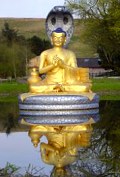
 Before reading on, and specifically before asking why I’ve used a picture of Buddha in an article about Ayurveda…it’s not Buddha, it’s Nagarjuna, redactor of the Sushruta Samhita a sixth century BCE text on surgery, the only treatise for two of the eight branches of Ayurveda. The snake is part of Nagarjuna and is usually depicted as a protective canopy, I’ve never seen Buddha depicted in that way. Apologies for any confusion, but please no more comments or emails telling me I’ve used an inappropriate photo. I don’t believe I have.
Ayurvedic medicines can contain dangerous quantities of heavy metals, including lead, mercury, thallium and arsenic, clinical toxicologists in London have warned. Writing in the International Journal of Environment and Health, they suggest that recent European legislation aimed at improving safety of shop-bought products will have little impact on medicines prescribed by traditional practitioners, imported personally from overseas or bought over the Internet.
The problem is that the heavy metals are not simply inadvertent contaminants of natural herbal products, they are added deliberately in order to supposedly return the body to health by rebalancing allegedly essential minerals. You can read the full article on this via AlphaGalileo.
There are wide and wild claims for Ayurvedic medicine including the ability to treat diabetes, flue, cancer, asthma, flu, acne, boils, diarrhoea, headaches, and that perennial of the alternative remedy market, sex drive. Unfortunately, Ayurveda, although ancient, is no panacea.
Some practitioners are hoping to modernise the Ayurvedic system. However, until it is more widely recognised among users that adding arsenic, lead, thallium and other potentially toxic heavy metals to so-called medicinal preparations is unacceptable, it will remain a practice more associated with the past than contemporary medicine.
Paul I. Dargan, Indika B. Gawarammana, John R.H. Archer, Ivan M. House, Debbie Shaw, David M. Wood (2008). Heavy metal poisoning from Ayurvedic traditional medicines: an emerging problem? International Journal of Environment and Health, 2 (3/4), 463-474