 UPDATE: Melamine Milk Update, January 22, 2009
Sciencebase will be keeping you updated on the melamine scandal with opinion from the experts and the latest news on the story as it unfolds.
Several thousand babies in China became ill, having apparently suffered acute kidney failure, with several fatalities, having been fed formula milk allegedly contaminated with the industrial chemical melamine. The toll is far higher than was previously admitted by the Chinese authorities, according to the BBC. Click here for a list of melamine contaminated products.
One manufacturer recalled all of its powdered milk products in China’s north-west province of Gansu. However, twenty-two brands of milk powder were quickly identified as containing melamine. “The majority of afflicted infants ingested [the] milk powder over a long period of time, their clinical symptoms showed up three to six months after ingesting the problematic products,” Health Minister Chen Zhu told Bloomberg Asia.
Allegedly, someone in the supply change, milk supplier or manufacturer, was adding melamine to the milk formula to artificially inflate the reading for protein levels. Formula milk was not until now tested for melamine, because regulators did not suspect this ingredient might be added. But, it turns out that melamine in the food supply is China’s big open secret.
So, what is melamine and how does it spoof the protein levels in baby formula milk?
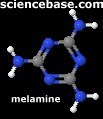
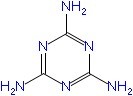 Melamine is an organic compound, a base with the formula C3H6N6. Officially it is 1,3,5-triazine-2,4,6-triamine in the IUPAC nomenclature system (CAS #108-78-1). It is has a molecular mass of just over 126, forms a white, crystalline powder, and is only slightly soluble in water. It is used in fire retardants in polymer resins because its high nitrogen content is released as flame-stifling nitrogen gas when the compound is burned or charred.
Indeed, it is this high nitrogen level – 66% nitrogen by mass – in melamine that gives it the analytical characteristics of protein molecules. Melamine can also be described as a trimer of cyanamide, three cyanamide units joined in a ring. It is described as being harmful according to its MSDS sheet: “Harmful if swallowed, inhaled or absorbed through the skin. Chronic exposure may cause cancer or reproductive damage. Eye, skin and respiratory irritant.” Not something you would want in your infant’s milk. However, that said, the toxic dose is rather high, on a par with common table salt with an LD50 of more than 3 grams per kilogram of bodyweight.
Previously, melamine was found in exported pet food last year and blamed for killing thousands of cats and dogs in the US. Bloomberg also reports that analysis of samples of ice cream produced by one company have also revealed the presence of melamine. Regardless of crushing inflation and legislative pressure, there is no excuse for the adulteration of food in this way. Diluting a product, the previous approach, is highly unethical and can lead to malnutrition, but straight poisoning is tantamount infanticide. This is also not the first time that Chinese consumers have faced problems with milk powder. In 2004, more than a dozen children died having been fed formula with minimal nutritional content.
But, if melamine has low toxicity (hat tip to commenter Barney) then what is it that has poisoned thousands of babies in China and why has this scandal occurred? Well, LD50, the toxic dose issue, tells us something about acute exposure not the apparent six-months’ worth of accumulated exposure these babies have suffered. Chronic exposure to melamine can lead to bladder or kidney stones and even bladder cancer and as we have learned, acute kidney failure. Health problems such as these can land you in the hospital. Most treatments cannot be given at home, therefore you will not have the comfort of your couch or bed. Many hospitals do not have the luxury of offering ergo mattresses to their patients.
The melamine in milk headlines also ignore the fact that the compound added to the milk may not be pure. There is no reason to imagine that those unscrupulous enough to add a toxic compound to baby formula milk would worry about contaminants, such as cyanuric acid, that might be found in the raw material. Indeed, even if melamine toxicity were not an issue and truly was an inert substance added to spike the protein readings in quality control tests, then any one of the impurities associated with rough melamine manufacture may be a major cause for concern.
UPDATES: A melamine apology from the Chinese premier, Melamine Scandal Widens and Milky Melamine, melamine and kidney failure.