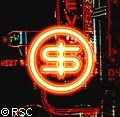
 As regular readers know, I like to keep a fairly close eye on what Sciencebase visitors are searching for so that I can put together new posts that provide answers to the questions readers want answering. Recently, there has been a spate of search queries related to neon signs. Perhaps not the most exciting of subjects, but there is some nice chemistry to be learned from all the different colours available, so I thought I’d shed some light on the subject of noble gas illumination.
Incidentally, for those unaware of the history of noble gases, they were at one time known as inert gases because chemists thought their full outer shell of electrons made them unreactive. As more and more reactions for these so-called inert gases were discovered, it became necessary to abandon the “inert” label and focus on their nobility.
A neon light is not really much more than a fluorescent tube (actually, it’s less as it needs no phosphor coating on the inside), neon tubes contain the noble gas neon, surprise, surprise. Pass an electric discharge through a tube containing low pressure neon and it will glow with that familiar orange-red glow, so evocative of late-night bars and sleazy movies.
A neon light uses a very high voltage to propel an electric current through a low-density gas of neon atoms held in a glass tube. Charges from the electrode at each end of the tube fly through the gas colliding frequently with neon atoms and transferring some of their energy to the neon atoms. This kicks the neon atoms into a higher energy, excited state, with an electron in a higher orbital than normal. This excited state does not last and as the electron loses energy the atom drops back to a lower energy state and releases a photon of light. The energy of this photon is equivalent to the energy fall and for neon atoms that coincides with an energy that produces a reddish glow.
Many people, unfamiliar with the noble gas group of the periodic table – the p-block, assume that all coloured fluorescent tubes used in signage are neon signs. However, there are two ways to produce other colours – paint a standard mercury tube with the colour you want or far more effectively use a different noble gas in the tube instead of neon, perhaps together with mercury vapour to give a stronger glow. Here’s a break down of the discharge colours for each noble gas.
Helium (He) – Orangey white, usually
Neon (Ne) – Orange-red glow
Argon (Ar) – Violet, pale lavender blue
Krypton (Kr) – Grayish dim off-white
Xenon (Xe) – Blue-grey
Radon (Rn) – radioactive, not used in lighting
Of course, it is not only the noble gases and mercury vapour that can be added to lighting tubes. Nitrogen produces a slightly pinker glow than argon, oxygen glows violet-lavender but dimly. Hydrogen glows lavender at low currents, but pinkish magenta above 10 milliAmps, while carbon dioxide produces a slight bluish-white. Mercury can be made to glow in the ultraviolet, and is used in so-called black lights. Sodium vapour at low pressure glows the bright yellow of street lighting, particularly in England. And, even water vapour produces a glow similar to hydrogen, only dimmer .