
Apr 18, 2008
Rebuilding the Periodic Table
The Periodic Table of the elements is a fascinating icon of science. It is incredibly useful and has been exploited and sexploited too in the form of a periodic table of yoga and a sexy PT. It has also been hacked apart, cut and paste into different formats, created as illuminated wall cases, woodworked into furniture, spiralled, spherized, and generally rebuilt in almost every imaginable way ever since Mendeleev first dreamed of laying out his elemental cards according to the periodicity of elemental properties.
Now, in an effort to inspire chemists to reconsider the foundations of the periodic table, chemical philosopher Eric Scerri of the University of California, Los Angeles, is building a new way to classify the chemical elements one step at a time.
Writing in the latest issue of the Journal of Chemical Education (PDF 2008, 85, 585-589), Scerri explains how the periodic table initially arose from the discovery of atomic weight triads but he now suggests that chemists should recognize the fundamental importance of atomic number triads.
This sea change in elemental attitude might enhance the periodic table by classifying the elements at a fundamental level as basic substances. As such, he and his colleagues have developed a new version of the “left-step” periodic table, which looks very different from the conventional PT. In the new layout, with its step-like pattern actinides and lanthanides are no longer relegated to a standalone box, but form the first step of the PT.
Climbing right to the transition metals (Fe, Mn, Ir, Sg et al) on the next step and then to the non- and semi-metals, such as boron carbon, oxygen, silicon etc and finally a step in which the halogens (fluorine, chlorine…), noble gases (neon, xenon…), alkali metals (potassium, sodium…) and alkaline earth metals (beryllium, calcium…) form the final highest step on the right. Hydrogen tops the halogen column and helium crowns the noble gases rather than acting as the outer beacons as with the conventional layout. (Click the graphic for a clearer, full-size view).
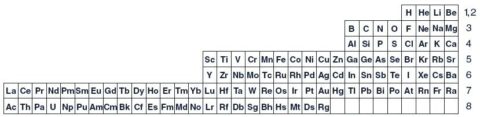
“The left step table has been around for some time,” Scerri told me, “but I am modifying it to accommodate two atomic number triads which would otherwise be absent. They are He, Ne, Ar which ceases to exist as a triad in the usually encountered left-step table and H, F, Cl which does not exist either in the conventional medium-long form table or the usually encountered left-step table.”
In the grander scheme of things, whatever form the Periodic Table takes in the future matters not to those of us who sing, so we end with a song, the periodic table song from Tom Lehrer (who was 80 on April 9, 2008 and gets a mention in the Official Google Blog this week), known simply as The Elements.


“HOW VERY TEDIOUS!” AND “INCOMPREHENSIBLE”
writes Scerri regarding Bent’s long comments.
Of course! Perfectly put!
Imagine this:
You have a theory: He/Ne (Helium belongs above neon in periodic tables). You’re holding onto it tightly when along comes a book that, line after line, paragraph after paragraph, and page after page, for over 190 pages, demolishes your theory while making the case, time and again, for an alternative theory.
How are you going to feel about that book — or a part of it on a blog?
“How very tedious!”
So, too, in so many words, said a (He/Ne)-lover and reviewer of “New Ideas”.
Another thing said: It’s “INCOMPREHENSIBLE!”
To whom? The man in the street?
I’ve an intelligent brother, a physicist, supportive of my campaign for He/Be, who freely admits that some arguments for He/Be — which, for a life-long chemist, seem obvious — go right over his head.
Called to mind is a remark by a participant in an NSF/AAAS Chautauqua short course for college teachers on Thermodynamics, Art, Poetry, and the Environment. “Dr. Bent,” said the participant after a session, “I think perhaps it’s time that you retired from themodynamics for a while.” I knew what he meant. We had a rule in the department of chemistry at the University of Minnesota that the noted physical chemist and infrared spectroscopist Bryce L. Crawford should not be permitted to teach the undergraduate p. chem. course two years in a row, because by the second year everything was “obvious” to the instructor.
No doubt PK has seen students asleep in classes because what’s being said is “tedious” because “incomprehensible”.
To characterize an argument as “tedious” and “incomprehensible” is to run the risk, however, of being deemed uncomprehending.
Revealed are two additional tools in our provocateur’s kit: declarations that an argument is tedious and/or incomprehensible.
Regarding a scientific and pedagogical issue, consider -
CONSTRUCTION OF PERIODIC TABLES FROM SCRATCH
How do you do that for beginners?
Can one base the construction on a set of simple axioms,
in an Aristotelian approach to the Platonic Ideal of an axiomatized system?
(Construction of any one table is sufficient for construction of all tables, since all satisfactory modern tables are topologically equivalent to each other, and exhibit the same Groups.) Five responses:
(1) Tell the truth (when in doubt, said Mark Twain). Tell it as it happened: Dobereiner’s triads, Newland’s Octaves, de Chancourtois’s helix, &c.
“Boring!” say students. To enjoy history one needs to have a history.
History of the periodic table is for periodic table buffs, not periodic table beginners.
(2) Use Madelung’s Rule. From where? Periodic table’s shapes. The argument is circular. Further more, exceptions to the rule exist.
(3) Apply Table Construction Conventions to an annotated Mendeleev Line (NI, front cover), with sequences HNAE and CV (H Halogen, N Noble Gas, A Alkali Metal, E Alkaline Earth Metal; C Coinage Metal, V Volatile Metal).
Two questions: (a) How does one know how to annotate the Line? (Historically, Tl was often put in Group I, Mg and Pb in Group II, Be and Cr in Group III.) and (b) Where do the Construction Conventions come from? Periodic table’s shapes? The argument, again, is circular — as, indeed, are all arguments that rely on true inductions.
(4) Apply Table Construction Conventions to elements’ maximum oxidation numbers (NI, Section 11). The results are the same as in (3), if not as impressive, owing to absence of oxidation number sequences corresponding the CV sequences, owing to existence of states of oxidation of the coinage metals higher than +1.
Methods (1), (3), and (4) have the virtue with beginners that they do not require knowledge of atomic orbitals, or even of electrons.
(5) Apply Table Construction Conventions to atoms’ first stage ionization energies. Atomic orbitals need not be mentioned. (Even the word “electron” can be avoided, through use of an operational definition of 1st stage ionization energy.) Major and minor zig-zags in and IE vs. Z plot correspond to the HNAE and CV sequences in Method (3).
My preferred method? Methods (3), (4), and (5), in that order.
Said the Bellman, “What I tell you three times is true.”
The result (arrived at in three ways) is (accordingly) a “natural” classification (Whewell).
It might appear at first glance that the first zig-zag of an IE vs. Z plot, namely H (medium high) He (highest) Li (very low) Be (higher), places H and He above the second zig-zag’s zig: F and Ne. The COMPLETE PICTURE reveals, however, that, for maximum regularity, overall, the first zig-zag should be interpreted as two zags. Remember –
THE PERIODIC SYSTEM IS, ABOVE ALL ELSE, A SYSTEM.
All parts of it are related to each other through their contributions to the System’s OVERALL SHAPE.
The overall shape of a periodic table is its most important property.
It should be foremost in one’s mind when moving elements around in order, e.g., to “maximize the number of triads”.
Do the moves maximize, also, the table’s TOTAL NUMBER of arithmetical regularities?
TOTAL NUMBER OF REGULARITIES
The change H/Li and He/Be to H/F and He/Ne actually diminishes a periodic table’s total number of arithmetical regularities!
(Arithmetical regularities arising from triads are only one part of a periodic table’s total number of arithmetical regularities.)
Elevating a Principle of Triad Maximization over the Principle of Maximum Arithmetical Regularities elevates a part over the whole. It’s –
AN ELEMENTARY PHILOSOHICAL MISTAKE
unless one can argue that some regularities are more fundamental than other regularities.
Triad regularities are, however, less fundamental than row-length regularities.
Row-length regularities — a consequence of the Pauli Exclusion Principle and the important quantum mechanical expression (2 l + 1) — are one of the reasons for occurrence of triads, not vice-versa.
Triads are NOT the reason for row-length regularities.
“Maximizing number of triads” naively elevates a Triad Principle over the Pauli Exclusion Principle and the quantum mechanical principles embodied in the expression (2 l + 1).
It gets everything backwards! It puts the cart before the horse!
A QUESTION FOR OUR PROVOCATIVE PK:
Help us understand your position on periodic tables.
How do you construct from scratch for beginners a periodic table?
No such method is described in your book.
AN UNEXPECTED CONCLUSION
As a chemist one takes pride and as a teacher pleasure in capturing the periodic table from chemical data without reference to atomic orbitals, which, in many-electron systems, our PK may agree, are, strictly speaking, nonexistent.
It’s philosophically unsatisfying to think that the Central Science’s Central Icon is based on a physical approximation!
The Periodic System is explained by a physical approximation, but based on chemical inductions.
Nonetheless, it is a fact: There exists a striking Concordance between the ordinal numbers generated by periodic tables and the integers generated by an orbital interpretation of Madelung’s Rule.
If “right” means “extremely useful” and “real” means “so useful one cannot imagine doing without, in one’s mental map of the world, the thing asserted to be real”, then the orbital interpretation of the Periodic System comes very close indeed to allowing one to say that, for many practical purposes, “orbitals are real”.
Philip,
I admire your deep knowledge of issues connected with the peirodic law. I understand that you are not a pro also. What is your background in Chemistry?
Valery: Knowing a lot of chemistry does not make you a pro; what counts is that you don’t have a vested interest to defend. It’s interesting to know how you arrived at the tetrahedron – not Platonically at all! I did a lot of work on my ‘galaxy’ with drawing pins and pieces of string.
@Philip, You are “right in saying that [I] had no professional chemist’s baggage to shed”.
The condition persists.
I never took chemistry because of the stupid periodic table that belied the periodic law in such an obvious manner that even a mediocre high school student could see.
Philip,
I have to confess that I have some background in chemistry that goes beyond High school curriculum. I am structural engineer by profession. Chemistry and Material Science are very important parts of engineering curriculum (at least they were in former Soviet universities). I was straight “A” student. I am not well versed in organic chemistry, though.