 Urine is a problem. Huge volumes are flushed, with fresh water, into the world’s sewage systems and then enormous volumes of yet more water are used to treat the waste along with solids. However, writing in a forthcoming issue of the Inderscience publication, International Journal of Biotechnology (2008, 10, 45-54), fellow journalists can email me if they want an advance copy of the paper) researchers in China and Russia describe how microbes could be used to convert liquid urine into a phosphorus and nitrogen rich biomass for use as feed, fertilizer and fuel.
Bioengineer Hong Liu of Beijing University of Aeronautics and Astronautics and colleagues Chenliang Yang, Ming Li, and Chengying Yu are working with Gurevich Yu, of the Russian Academy of Sciences, Siberian Branch, in Krasnoyarsk, to develop a more environmentally benign and potentially useful method for handling urine.
The researchers point out that the direct discharge of urine into lakes and rivers causes eutrophication because of the high levels of phosphorus and nitrogen. Treating human urine to make it safe to discharge into water is difficult and produces large amounts of waste by-product because urine is a complex mixture of compounds.
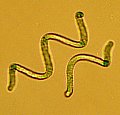
The researchers have now turned to the blue-green alga, Spirulina platensis, well-known, but controversial, as a health food supplement with claims of beneficial effects on cholesterol levels and blood pressure. Advocates also point to clinical evidence of benefits in treating malnourishment and anaemia in children with and without HIV, in protecting the heart from the toxic effects of the anticancer drug doxorubicin in chemotherapy, and even in preventing hay fever.
Spirulina platensis, now classified as Arthrospira (Spirulina) platensis (Nordstedt) Gomont does indeed contain several vitamins and minerals in large quantities, has a high protein content, and contains just 5-6% of good quality fat. Previous researchers have shown that this alga can grow on nitrogen-derived from urea (the nitrogen-containing component of urine) to release oxygen and produce solid biomass as it does so.
Liu and colleagues have now optimized the alkalinity of the fermentation mixture of Spirulina platensis to pH 9.5 as well as determined the best urine dilution ratio for most rapid growth. They warmed the brew to between 28 and 30 Celsius and bathed it in red and green light from an array of light-emitting diodes (LEDs). This stimulated metabolic activity. They were able to convert 99.99% of urine samples at the optimum dilution into solid biomass using Spirulina.
“Our future focus will be to make Spirulina platensis consume the nutrient component more quickly and to obtain more biomass,” the researchers say. They add that, “Spirulina platensis can be used as fertilizer, bait, and even a food and health product, is of great economic value.”
There could be a large market for urine-made Spirulina as an agricultural fertilizer or fish bait but perhaps this particular production method will not suit health food advocates. In fact, I’d go so far as to say they really are taking the P.

 Yang, C., Li, M., Yu, C., Yu, G., & Liu, H. (2008). Consumption of nitrogen and phosphorus in human urine by Spirulina platensis International Journal of Biotechnology, 10 (1) DOI: 10.1504/IJBT.2008.017987