
Apr 18, 2008
Rebuilding the Periodic Table

I’m bored with looking at the standard periodic table on my office wall. It has been useful over the years, of course, and has been exploited and sexploited too in the form of a periodic table of yoga and a sexy PT. It has also been hacked apart, cut and paste into different formats, created as illiminated wall cases, woodworked into furniture, spiralled, spherized, and generally rebuilt in almost every imaginable way ever since Mendeleev first dreamed of laying out his elemental cards according to the periodicity of elemental properties.
Now, in an effort to inspire chemists to reconsider the foundations of the periodic table, chemical philosopher, best-selling science author and my good friend, Eric Scerri of the University of California, Los Angeles, is building a new way to classify the chemical elements one step at a time.
Writing in the latest issue of the Journal of Chemical Education (PDF 2008, 85, 585-589), Scerri explains how the periodic table initially arose from the discovery of atomic weight triads but he now suggests that chemists should
recognize
the fundamental
importance of atomic
number triadschemists should recognize the fundamental importance of atomic number triads.
This sea change in elemental attitude would enhance the periodic table by classifying the elements at a fundamental level as basic substances. As such, he and his colleagues have developed a new version of the “left-step” periodic table, which looks very different from the conventional PT. In the new layout, with its step-like pattern actinides and lanthanides are no longer relegated to a standalone box, but form the first step of the PT.
Climbing right to the transition metals (Fe, Mn, Ir, Sg et al) on the next step and then to the non- and semi-metals, such as boron carbon, oxygen, silicon etc and finally a step in which the halogens (fluorine, chlorine…), noble gases (neon, xenon…), alkali metals (potassium, sodium…) and alkaline earth metals (beryllium, calcium…) form the final highest step on the right. Hydrogen tops the halogen column and helium crowns the noble gases rather than acting as the outer beacons as with the conventional layout. (Click the graphic for a clearer, full-size view).
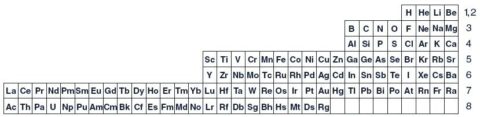
“The left step table has been around for sometime,” Scerri told me, “but I am modifying it to accommodate two atomic number triads which would otherwise be absent. They are He, Ne, Ar which ceases to exist as a triad in the usually encountered left-step table and H, F, Cl which does not exist either in the conventional medium-long form table or the usually encountered left-step table.”
In the grander scheme of things, whatever form the Periodic Table takes in the future matters not to those of us who sing, so we end with a song, the periodic table song from Tom Lehrer (who was 80 on April 9, 2008 and gets a mention in the Official Google Blog this week), known simply as The Elements.


Nature Reviews Drug Discovery


Egon Willighagen said,
April 21, 2008 at 6:03 pm
Mmm… the image is not clickable for me… Do you also have a link to the high-res version?
David Bradley said,
April 21, 2008 at 7:00 pm
Thanks for spotting that Egon…fixed now.
db
Marc said,
April 22, 2008 at 2:09 pm
Hi, Egon, Hi David
link to New Periodic Table of the Elements:
http://www.egregoralfa.republika.pl/english/newtable.html
Greetings from Poland,
marc
David Bradley said,
April 22, 2008 at 2:36 pm
It looks interesting, but it’s going to be a devil for young chemistry students to re-draw and work with!
db
Marc said,
April 22, 2008 at 3:42 pm
it’s very easy PT
marc
David Bradley said,
April 22, 2008 at 3:44 pm
I’m sure it is once you know the chemistry and have learned the format, but a quick glance from a first-year undergraduate or a high-school student used to the standard PT is going to confuse all but the brightest. At least Scerri’s version resembles the Mendeleev PT albeit arranged differently. This one looks superficially to be far more complicated but more to the point will be difficult to draw with out a set square.
db
JonRSC said,
April 23, 2008 at 10:35 am
There have been a few interesting redesigns of the PT! The “Alexander arrangement” is a personal fave, as it sticks with Mendeleev’s groupings but connects the periods in a natural, linear way. Methinks we need a Mobius PT.
Alexander arrangement example (also makes a neat and geeky desk tidy):
http://allperiodictables.com/ClientPages/AAEpages/saleInteractive.html
Anyway, some of the wackier ones that I enjoyed:
http://www.periodicspiral.com/
http://www.nfinity.com/~exile/periodic.htm
I did like Marc’s one, once I’d decoded it. It seems the representation of orbitals is chief in the budding PT redesigner’s mind.
David Bradley said,
April 23, 2008 at 11:11 am
A Moebius PT would be even tougher for new chem students than Marc’s I think. Great fun but tough
db
Marc said,
April 23, 2008 at 11:35 am
Hi, David
Try to look at the PT not like an chemistry teacher, but like an chemist or physicist.
Marc
David Bradley said,
April 23, 2008 at 1:34 pm
Point taken Marc. I wonder if Prof Scerri has any thoughts on your format. I’ll drop him a line.
db
Roy Alexander said,
April 23, 2008 at 3:48 pm
JonRSC,
Glad to see that your ‘fave’ is mine also.
It certainly answers for “a quick glance from a first-year undergraduate or a high-school student”, as it was developed to encourage rather than discourage, as most others do.
The multiple discontinuities in the standard chart, in light of the periodic law’s suggestion that the “elements be arranged in order” turned me away from a life as a chemist. (Well, at least turned me off becoming a chemistry student.)
Roy
Ertc Scerri said,
April 23, 2008 at 4:46 pm
Hi folks,
Good to see these alternative tables. I would be interested in hearing the claimed scientific/educational advantages the triangular table from Poland?
Eric Scerri
UCLA
Roy Alexander said,
April 23, 2008 at 7:56 pm
As “Alexandre Béguyer de Chancourtois was the first person to list the known elements in order of increasing weight of their atoms“, and his arrangement was a 3D spiral, perhaps the flattened tables subsequently promoted might be considered the “alternative tables“, handy to fit inside book covers and stuck on walls for convenient reference, but not what they should be - or would have been had Mendeleev seen the vis tellurique before doing his card thing.
Is the Alexander Arrangement of the Elements 3D helical tale a return (all the way) to basics?
Roy
Roy Alexander said,
April 23, 2008 at 8:02 pm
correction: Alexander Arrangement of the Elements 3D helical table a return (all the way) to basics?
David Bradley said,
April 26, 2008 at 4:53 pm
Marc it would be useful if you could summarize the main bullet points for us here, thanks
db
Marc said,
April 27, 2008 at 12:37 am
Do you ask about this alone what Prof Scerii?
marc
Eric Scerri said,
April 27, 2008 at 4:32 am
One important thing to bear in mind concerning alternative periodic tables.
It’s not the shape that matters or whether it’s 2-D or 3-D. These are just cosmetic aspects.
What constitutes really alternative tables are those that place certain elements in different groups than what is done in the conventional medium-long form.
For example the left-step table as first proposed by Janet does this since it places He in the alkaline earths.
My table published in Journal of Chemical Education (April issue) also qualifies since it places H in the halogens.
Then there are variations depending on what elements are placed below Sc and Y in group 3 (IUPAC numbering).
Some tables place La and Ac in these places, others place Lu and Lr.
For more information please see my recent book on the periodic table.
The Periodic Table, Its Story and Its Significance, OUP, 2007.
eric scerri
UCLA
Department of Chemistry & BIochemistry
David Bradley said,
April 27, 2008 at 10:10 am
Good point Eric. If the novel PT does nothing but change aesthetics then it’s pointless but if it improves understanding of elemental properties too then that’s the way forward.
db
David Bradley said,
April 28, 2008 at 4:25 pm
Yet another reason the old periodic table needs an overhaul lies with the discovery of a superheavy element (atomic number 122 and weight 282) - http://arxivblog.com/?p=385
db
Roy Alexander said,
April 28, 2008 at 5:20 pm
JonRSC, I notice that you said that the Alexander Arrangement “makes a neat and geeky desk tidy.” I have wondered whether people took advantage of the caddy adaptation. Mine is here
David Bradley said,
April 28, 2008 at 5:47 pm
Nice one Roy…
db
Roy Alexander said,
April 28, 2008 at 5:47 pm
JonRSC also questioned if there was a need or a moebius periodic table.
If quantum physicists ever get their act together, an Alexander Arrangement might be created to do just that.
Before identifying basic antimatter, however, we will have to determine where matter ends in order to continue (if you will) the continuum of both the Alexander Arrangement and the Moebius strip.
Along these lines, David Bradley mentions “the discovery of …atomic number 122”.
Is this a discovery or a creation?
Are the supercolliders of those on the dark side keeping up with us, or must we end our periodic table of basic substances with naturally found matter and hope it matches (opposes?) theirs?
Roy
Roy Alexander said,
April 28, 2008 at 6:18 pm
Eric says that it’s not the shape of a periodic table that matters, and that these are “just cosmetic aspects”.
A 3D periodic table can constitute a real alternative to flattened tables by permitting placement of elements in better conjunction (like next to each other) as well as in different groups than what is done in the conventional medium-long form.
For instance, the “Hydrogen Crown” of the Alexander Arrangement not only starts the table with H in the usual spot, but loops it over the Non-Metals, and then attaches (beside the element in the following group,) over the Halogens - the triads working pretty well for all of them (except, oddly, for the Noble Gases.)
Try that in two dimensions!
Roy
David Bradley said,
April 28, 2008 at 6:48 pm
Point taken Roy, but try publishing a 3D periodic table that can easily be posted on the classroom wall. That said, I’m sure there’d be a way ;-)
Roy Alexander said,
April 28, 2008 at 7:34 pm
Right David, that is a problem.
Mercator “solved” the flat classroom wall problem of another inherently 3D object, with similar distortion as in the flattened periodic table.
Valiant corrective attempts by others have been made to no avail.
Back to the Flat Earth concept, so helpful for understanding. ;-)
eric scerri said,
April 28, 2008 at 7:49 pm
Actually, you are right Roy and I was a little quick in my comments. 3-D tables and some 2-D tables such as the pyramidal table can highlight what are sometimes called secondary relations such as between Ti and C or V an d P or Cr and O.
eric scerri
David Bradley said,
April 28, 2008 at 8:19 pm
Roy, your comment reminds me of a high school geography lesson in which the teacher took most of the first lesson of term trying to squeeze out of his charges exactly why a map was of such limited use in some contexts…
I understand that having a 3D version of the periodic table might offer new insights into the relationships between the elements, but a periodic table is not intrinsically a 3D object in the same way that the earth is 3D, any PT is just an arrangement of distinct species formated to appeal to our observations of particular patterns. That said there are obviously more insights to be gained from placing those arbitrary species in a particular arrangement, but one of the advantages of a 2D representation has to be convenience, surely. After all, who carries a globe with them when they go orienteering?
db
Roy Alexander said,
April 29, 2008 at 2:19 am
David, I imagine that one would not carry a globe when orienteering – unless planning VERY long distances.
In a first high school geography class, however, the globe might be an excellent first lesson, as there would be no continental distortions, ie.; South America would not look the same size as Greenland.
In a first chemistry lesson, should instructors feel that the best way to introduce chemistry is with the many gaps and discontinuities of the flattened periodic table? Would it not be better for the students to – literally – get the feel of the blocks, see the atomic numbers all in unbroken succession, find that the rare earths are not just an addendum?
Later, admittedly, for purposes of convenient reference, the flattened chart must necessarily be introduced, and used (like a cheat sheet) in its many permutations from then on, just as folded and/or wall maps serve us so well.
Especially while orienteering.
Also, you state that the periodic table “is not intrinsically a 3D object” yet the very first functional one, by de Chancourtois, was 3D (seven years before Mendeleev did his best, handicapped by never seeing the original.)
Even you must admit that even today, 3D’s a lot less boring.
Roy
David Bradley said,
April 29, 2008 at 7:30 am
Sure, I don’t disagree! And, yes, that point about continental scale was the very issue my high school geography teacher was trying to make. 3D is certainly a lot less boring that 2D for most things. As to any intrinsic 3Dness to the way we arrange the elements, I simply meant that the elements is just the elements, there’s no intrinsic arrangement 3D, 2D or otherwise, PTs are organisational patterns we stamp on them, although hidden within those patterns are revealed other patterns depending on the choice of motif used.
db
Mark Leach said,
April 29, 2008 at 8:14 am
Dave, I have a collection of PT formulations here.
Scroll down and find one you like…
(Actually, I have a few to add in a to-do folder, and I think that I am going to modify the page so that it is database driven.)
Mark
David Bradley said,
April 29, 2008 at 8:29 am
Looks interesting Mark, thanks for the links
db
Steve Beck said,
April 29, 2008 at 9:34 am
I do not disagree on any particular point. However, any PT will lose inherent value if the information it represents graphically is lost in translation. The possibility also exists, abstractly, our understanding of the elements falls short of explaining the great masterful pattern or order of all things. The philosophical scientist will always wonder which properties are most important. I believe it depends on the chemist and their field of study. That Periodic tables can be redesigned is essential to the evolution of chemistry and the dynamic exploration of WHY and HOW.
Roy Alexander said,
April 29, 2008 at 3:49 pm
Gee, David, I have been working all these years to relieve your boredom (“I’m bored with looking at the standard periodic table”) that you started this whole thing about!
You are hard to interest, but the Alexander Arrangement’s main goal has been to interest the uninitiated, the new student.
I suppose once one has gone deeply into the flattened table for the many reasons a professional does, that it is hard to understand (or remember) the distress of a newby at seeing a chart so complex plus so disjointed.
Those that are not so fussy, may go on to become chemistry or biology students, and the others are never seen by instructors of these branches of science, who, therefore, due to this preselection, remain firmly convinced that the flattened table is just fine for kids.
Roy
David Bradley said,
April 29, 2008 at 3:52 pm
Hands up Roy, I guess I argued myself into a circle…I hope this little discussion has encouraged readers to check out yours and other alternative PTs…
db
Roy Alexander said,
April 29, 2008 at 3:56 pm
David,
I may be missing something.
You said “there’s no intrinsic [element] arrangement 3D, 2D or otherwise.”
I thought there was a Law.
Roy
Roy Alexander said,
April 29, 2008 at 4:02 pm
Sorry David,
I hadn’t seen your last response before I called the Law on you.
Great discussion!
Roy
David Bradley said,
April 29, 2008 at 4:15 pm
Yeah, there is a Law, of course, but it doesn’t physically arrange anything does it, not like a globe represents in a scaled down version, the Earth? The elements are only linked through our imaginings they themselves exist independently of one another.
db
Jim Rota said,
April 30, 2008 at 8:20 pm
Nice blog!
The Rota Period is easy to understand because it is based upon valences.
Re-inventing the Wheel - A New Periodic Table
http://www.rotaperiod.com
I have a question about orbitals: can anyone explain (using orbital theory) why the positive valences only go as high as 8+ and the negative valences range from 1- to 4- ?
Related to this question: if you compare the orbitals of Ge and As, Sn and Sb, Pb and Bi, is there an orbital theory explanation for the switch from positive to negative?
Likewise, if you look at the series of elements: Os, Ir, Pt, Au, Hg (which display a descending sequence of valence - i.e. from 8+ to 6+ to 4+ to 3+ to 2+), can this descending sequence be explained using orbital theory?
Jim
David Bradley said,
May 1, 2008 at 7:23 am
Thanks Jim! Be sure to grab the RSS feed to keep up to date with the site - http://www.sciencebase.com/feed
As to your question, I have a vague notion as to why, but am not 100% sure, so will leave that to someone with even greater chemical knowledge than I (not hard). I’ve also posted it as a question on another forum and will get back to you if anyone responds.
db
Larry Sacks said,
May 1, 2008 at 2:02 pm
In response to Jim’s question about the range of “valences” (let’s make that “charges”) - atoms gain/lose electrons to form ions that pack together with net loss of energy. Each successive loss costs more, as does each successive gain beyond the first. The loss of several electrons is possible if the resulting ion is sufficiently smaller to recover through greater Coulombic energy the work to remove the electrons (loss of all valence electrons often does this). Gaining more than four electrons requires too much energy and creates an unusably large anion; hence, even 4- ions are rare.
One feature of the proposed table with which I heartily agree is the placement of hydrogen among the other halogens. This is in accord with a description of its compounds as hydrides, exclusively, which provides both qualitative and quantitative descriptions of the bonding and structure of virtually all its compounds, from LiH to methane to acids (substances with an extractable proton - i.e. , having hydride ion(s).
Larry
David Bradley said,
May 1, 2008 at 2:06 pm
Thanks for answering Jim’s question Larry. Very useful.
db
Eric Scerri said,
May 1, 2008 at 10:01 pm
Dear Larry,
Thanks for your support over the notion of H in the halogens and your input.
I am wondering whether you might elaborate a little or provide references to your articles?
It occurred to me to perhaps scan part of your paper in Foundations of Chemistry and to post it here on this site if that’s OK with you?
regards,
eric scerri
Jim Rota said,
May 7, 2008 at 4:05 pm
While Larry’s general explanation is useful, I was looking for something more specific - i.e.,
> >>>
>
> My Question: I have a question about orbitals: can anyone explain (using
> orbital theory) why the positive valences only go as high as 8+ and the
> negative valences range from 1- to 4- ?
>
> >>>
What I was looking for here was something definitive - i.e: there are no 9+ because …
> >>>
> Related to this question: if you compare the orbitals of Ge and As, Sn
> and Sb, Pb and Bi, is there an orbital theory explanation for the switch
> from positive to negative?
> >>>
What I was looking for: Ge = [Ar] 3d10 4s2 4p2 and As = [Ar] 3d104s2 4p3 …what happens is that when the 4p orbital gets one more electron…
> >>>
> Likewise, if you look at the series of elements: Os, Ir, Pt, Au, Hg
> (which display a descending sequence of valence - i.e. from 8+ to 6+ to
> 4+ to 3+ to 2+), can this descending sequence be explained using orbital
> theory?
> >>>
What I was looking for: Os = [Xe] 4f14 5d6 6s2 , Ir = [Xe] 4f14 5d7 6s2 , [Xe] 4f14 5d9 6s1 , etc. The decending valence is because the d orbital …
It appears to me that while orbital theory “fits” nicely to explain the number of electrons, it does not explain valences very well at all!
eric scerri said,
May 7, 2008 at 9:51 pm
Jim,
Nice questions but I am not sure you are correct in calling this “orbital theory”.
I think you mean the electron configuration approach or the independent electron approximation model.
Orbital theory sounds too much like molecular orbital theory which of course is not relevant to these atomic cases.
eric scerri
Jim Rota said,
May 9, 2008 at 8:12 pm
I’m not sure about the distinction - almost all discussions about Orbital Theory usually talk about Electron Configuration, but okay…I am still interested in knowing if/how electron configuration and/or orbital theory can explain my questions…
Any idea who developed the Electron Configuration schema?
Jim Rota
Re-inventing the Wheel: A new periodic table